
Can myofascial release help with migraines?
If you have chronic migraines, you’ve probably tried everything from painkillers and rest, to avoiding triggers at work, play, or even your diet. And you may have noticed a pattern: when tension builds in your neck, shoulders, or jaw, your migraine symptoms may feel worse.
Myofascial release therapy may help reduce migraine symptoms by addressing tension and sensitivity within the muscle and connective tissues surrounding the head, neck, shoulders, and jaw. Many individuals with migraines experience increased muscle tightness and trigger points in these areas, which can contribute to pain, restricted movement, and heightened nervous system sensitivity. Myofascial release therapy can help reduce migraine frequency, pain intensity, and duration of symptoms during a migraine episode.
A registered massage therapist (RMT) starts by assessing areas of tension that may contribute to your migraines. They will then create a personalized plan that can include myofascial release techniques to help reduce migraine-related tension, pain intensity, and how often or how severely symptoms occur. With hands-on support, many people notice some relief after the first few sessions.
See a registered massage therapist
How can muscle tension and fascial restrictions trigger migraines and headaches?
Migraines are more than a “bad headache.” They’re a neurological event that can involve throbbing or pulsating pain—often on one side—along with nausea and sensitivity to light and sound. Physical activity tends to make them worse. They can last hours or days.
Tension-type headaches feel different: dull, achy, and pressure-like, usually on both sides of the head. They’re more directly linked to tight muscles. With a tension headache, you can often keep moving, but with a migraine, movement worsens the pain. Knowing the difference helps your RMT build the right plan for you.
So where does fascia come in? Think of fascia as the cling wrap that surrounds muscles, joints, nerves, and organs. This connective tissue holds everything together to help support movement and stability throughout the body. When it becomes tight or restricted from dehydration, poor posture, muscle overuse, inactivity, stress or tension, lack of recovery, and natural aging processes, it can limit movement and can contribute to the development of fascial restrictions or trigger points.
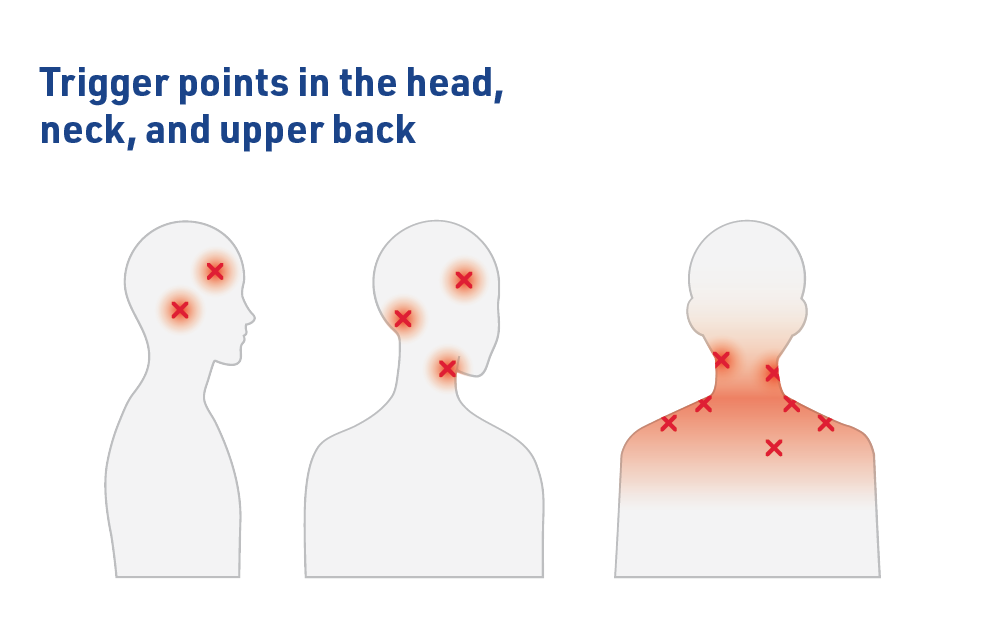
What are trigger points and how can they affect migraines?
Trigger points are tender, tight spots in a muscle that produce a predictable pattern of referred pain—meaning they can cause pain somewhere other than where the tension actually lives. According to Jason Blackwood, Lifemark’s National RMT Lead, sharing where you feel pain can help your massage therapist better understand what may be contributing to it:
”Tell your RMT where you feel the headache, because it could be a trigger point.”
For example, a tight upper trapezius muscle can cause pain to present in a question-mark pattern up the side of the head, which may feel similar to migraine-related head pain for some people.
Migraines have multiple contributing factors, which may include muscle tension, posture, lifestyle and stress, hormones, jaw clenching, neck movement, and even restricted blood flow. The nervous system is more reactive than average, so it responds more strongly and sometimes inappropriately, to internal or external stimuli. Neck and shoulder tension contributing to migraine symptoms are more common than many people realize. The good news is that myofascial release may help address several of these factors at once.
What is myofascial release and how does it work?
Myofascial release is a hands-on manual therapy technique that targets the fascia and the trigger points within it. Unlike a general relaxation massage, it uses gentle, sustained pressure held long enough to encourage the tissue to slowly soften and release. It’s performed without lotion, so the therapist can feel and work directly with the fascial layers.
As Jason puts it: ”Treat the fire, not the smoke.” Rather than just addressing the pain you feel, myofascial release therapy looks for the underlying tension patterns that may be contributing to your migraines in the first place.
What to expect at your first myofascial release massage therapy appointment
Your first appointment will start with a thorough interview: where the pain is, how long it lasts, how often it happens, what makes it better or worse, and what other symptoms come with it. Your RMT may also do a brief postural assessment and check your range of motion. From there, they'll create a plan tailored to you.
Treatment often focuses on the muscle groups that contribute to migraine symptom onset, intensity, or referral patterns. These can include the suboccipital muscles (at the base of the skull), the upper trapezius (upper back/neck) frequently overactive with stress and postural strain, the levator scapulae (in the back of the neck) frequently tight in desk-based or stress-driven postures, sternocleidomastoid (SCM) one of the most important referral muscles in headache presentation, the jaw muscles, and even the scalp. Your RMT may also work on the upper back and shoulders because the whole area functions as a connected system.
One more thing worth knowing: trigger points can be active (hurting all the time) or latent (only painful when pressed). Your RMT is trained to find both and to figure out whether the trigger point is contributing to your head pain, or if something else is going on.
How often do I need a massage for migraines?
While there isn’t a single fixed frequency for massage for migraines, an RMT may recommend sessions based on evidence-informed guidelines for your pattern of migraine severity, how often you experience an episode, and trigger load. This gives the body a chance to respond and lets the therapist work through layers of tension gradually.
If the migraines are connected to a postural issue—which is common—it typically takes around 4-6 sessions before the pattern starts to shift. Progress depends on how long the tension has been building and how the body responds to treatment.
As things improve, sessions often taper to monthly as a maintenance schedule. Your RMT will guide you based on how you’re feeling and how your migraines are changing. Massage therapy for migraines works best as part of an ongoing plan, not a one-time fix.
Jason’s simple rule of thumb for helping his clients with migraines:
- Frequent migraines: weekly support initially
- Improving migraine pattern: biweekly support
- Stable episodic migraines: monthly maintenance massages
How long does it take to feel relief?
Many people feel some relief after their very first session like increased mobility, less tension in the neck, or a sense of release they haven’t felt in a while. That’s the fascia responding to treatment.
For longer-term results, especially when migraines are tied to posture or chronic tension, give it a few consistent sessions. Improvement isn’t always linear, and your therapist will check in along the way. The goal is lasting change, not just getting through an appointment.
One timing note from Jason: it’s better to come in at the first sign of a migraine coming on, rather than during a full episode. For some people, treating during an active migraine may temporarily worsen symptoms. If you feel one starting, that’s your window to see an RMT to help prevent symptoms from becoming more intense.
What can I do at home to maintain results?
Between sessions, what you do at home can meaningfully extend your results. To help maintain the benefits of myofascial release and massage for migraines, your RMT will teach you the stretches, show you how to do them, and watch you do them before you leave, so you know you’re doing them right.
Upper trapezius stretch (scalene stretch): Tilt your ear toward your shoulder and hold for 30 seconds. Repeat 3-5 times. To get the most out of it, hold the seat of your chair with your opposite hand—this anchors the shoulder blade so the muscle gets a full stretch. Never bounce. Stretching should feel like a gentle pull, not pain.
Levator scapulae stretch: Tilt your ear toward your shoulder, then rotate your nose down toward your armpit. You’ll feel a deep stretch along the side and back of the neck. Hold for 30 seconds, 3-5 reps per side.
Suboccipital release: Lie on your back and place two tennis balls in a sock under the base of your skull. Let the head fully rest (don’t actively push your head down). Breathe slowly for 2-5 minutes.
Always warm up before stretching. Even a short walk or some gentle dynamic movement helps. Stretching cold muscles may increase the risk of strain or discomfort.
The goal is to help reduce re-accumulation of tension, improve mobility of tissues, and help calm the nervous system, so it doesn’t go back to being overly sensitive or easily triggered.
After a trigger point release, Jason also recommends applying heat to that area to increase blood flow and prolong the release.
Beyond stretching, here are a few other habits that can support your progress:
- Use cold therapy during a migraine. A cold pack on the forehead, temples, or back of the neck for 10-15 minutes with a cloth barrier may help calm blood vessel irritation and reduce pain. Some people also find a warm foot soak helpful at the same time.
- Stay hydrated. Dehydration may contribute to migraine symptoms and can make muscles feel tighter.
- Strengthen, not just stretch. Tight muscles at the front of the body (like the chest) often come with weak muscles at the back (like the rhomboids) and deep neck flexors. Strengthening those back muscles can help restore balance and reduce the postural patterns that drive migraines. Your RMT can guide you on this.
- Manage known triggers. High-sodium foods, bright lights, strong smells, and unmanaged stress can all contribute. Reducing input when you feel a migraine coming on—dimming lights, stepping away from screens—may help you manage symptoms.
- Diaphragmatic breathing. To help reset the nervous system, inhale through your nose for 4 seconds and exhale slowly for 6-8 seconds. Imagine filling a balloon in your belly with each inhale and allow your shoulders to relax. Do this for 3-5 minutes daily or during early symptoms of a migraine.
If migraines are cutting into your work, your sleep, and the moments with the people you love, it’s worth finding out what may be contributing to them. A Lifemark registered massage therapist can help assess muscle tension and create a care plan that fits your symptoms.
Key takeaways
- Trigger points in the neck, shoulders, and jaw can refer pain in patterns that feel similar to migraine-related head pain—tell your RMT exactly where you feel the pain so they can trace it to the source.
- Fascia and surrounding muscles may feel tighter with everyday factors like dehydration, stress, poor posture, and lack of movement.
- Myofascial release is not a cure, but it can be a powerful part of a larger treatment plan that includes home care, stretching, and lifestyle habits.
- Strengthening weak muscles matters just as much as releasing tight ones. Balance in the body reduces the postural patterns that may contribute to tension and migraine symptoms.
- The goal is to address possible contributing factors, not just the pain after it arrives.
FAQs
Can myofascial massage help with migraines?
Myofascial release may help reduce migraine pain intensity, frequency, or severity for some people, especially when neck, shoulders, jaw, or scalp tension Is part of their symptom pattern.
How is a migraine different from a tension headache?
Migraines typically involve throbbing, one-sided pain, light sensitivity, and nausea, and become worse with activity. Tension headaches feel dull and pressure-like on both sides and are more directly linked to tight muscles.
What are trigger points and how do they cause headaches?
Trigger points are tight, tender spots in a muscle that refer pain to other areas in a predictable pattern. A tight trapezius muscle, for example, can cause pain that travels up the side of the head, which may feel similar to migraine-related head pain.
How many sessions does it take to see results?
Many people may experience some relief after their first session. For chronic migraines tied to posture or long-term tension, 4-6 sessions are a common starting point before people notice a meaningful shift.
Should I get a massage during a migraine?
For some people, it may be better to come in at the first sign of a migraine, rather than during a full episode. Treating during an active migraine may temporarily worsen symptoms.
What stretches can I do at home for migraine relief?
The upper trapezius stretch and levator scapulae stretch are two of the most helpful for releasing neck and shoulder tension. Always warm up first, hold each stretch for 30 seconds, and never bounce or use momentum to push the stretch beyond a normal capacity, as that can cause injury.
Is myofascial release just for the neck and head?
Not always. Migraines can involve the upper back, shoulders, jaw, and even chest muscles. Your RMT will assess the full picture and treat wherever the tension patterns originate.
Do, T. P., Heldarskard, G. F., Kolding, L. T., Hvedstrup, J., & Schytz, H. W. (2018). Myofascial trigger points in migraine and tension-type headache. The Journal of Headache and Pain, 19(1), 84. https://doi.org/10.1186/s10194-018-0913-8
Rezaeian, T., Ahmadi, M., Mosallanezhad, Z., & Nourbakhsh, M. R. (2021). The impact of myofascial release and stretching techniques on the clinical outcomes of migraine headache: A randomized controlled trial. Journal of Research in Medical Sciences, 26, 45. https://doi.org/10.4103/jrms.JRMS_745_18